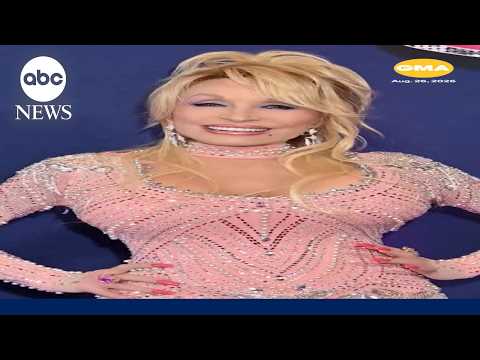
Dolly Parton’s Live Entertainment Legacy: Why Nashville and Theater Communities Celebrate Her

A recent video showing flowers, notes, and emotional fans gathering around Nashville has offered a striking reminder of Dolly Parton’s place in the city’s emotional architecture. The footage frames those scenes as a memorial, a claim that should not be treated as independently confirmed here. What it does capture, unmistakably, is the scale of feeling that Parton inspires in Music City and far beyond it.
That reaction makes sense. Dolly Parton is not merely a country star with a famously formidable wig collection. She is one of America’s great live-entertainment bridges: an artist whose songs have traveled from Appalachian roots to the Grand Ole Opry, Broadway pit orchestras, drag stages, stadiums, theme parks, karaoke bars, and the sort of late-night piano singalong that leaves everyone briefly convinced they can hit the high notes in “Jolene.” They cannot. They try anyway.
Nashville’s relationship with Dolly is bigger than a hit record
Nashville runs on mythology almost as efficiently as it runs on hot chicken and touring buses. Its musical heroes are not only heard; they are placed on pedestals, streetscapes, murals, museum walls, and, when the moment calls for it, in bouquets left by strangers who feel they have lost someone from the neighborhood.
The video points to tributes around the Country Music Walk of Fame, where Parton received a star in 2009, and mentions a tribute at the Grand Ole Opry. That setting matters. The Opry is not just another stage on an artist’s résumé. It is a ritual space in American music, where performers inherit traditions in public and audiences participate in keeping those traditions alive.
Parton’s Nashville story also carries the durable drama of a young artist arriving from East Tennessee with ambition that was larger than her circumstances. That narrative is central to her appeal, but it has never been only nostalgia. Her public image has made room for glamour and grit, business acumen and broad comedy, sequins and straight talk. Nashville, a city always negotiating the gap between heritage and commercial spectacle, recognizes the balancing act.
Why public musical tributes become community events
Flowers at a landmark are rarely just flowers. They are an improvised public language: a way to say, “This mattered to me,” without needing an invitation, a ticket, or a perfectly composed speech. A handwritten note can turn a sidewalk into a temporary town square.
For musicians especially, public tributes are different from private grief because songs are already communal property in the best sense. People remember where they first heard them, who played them in a car, which lyric got them through a breakup, and which one made a roomful of friends roar at closing time. The artist may have written the song alone; the audience has been carrying it around ever since.
Parton’s catalog is unusually suited to that kind of collective response. “Jolene” is a compact piece of melodrama with the clean lines of a folk ballad. “9 to 5” turns workplace frustration into a bright, sharp communal chant. “I Will Always Love You” has lived multiple lives across genres and generations. These are songs that don’t stay politely in a playlist. They demand a stage, a chorus, a costume change, or at minimum an overcommitted kitchen performance.
9 to 5 proved Dolly could own a theater without becoming theatrical
Parton’s impact on live entertainment is perhaps clearest in 9 to 5. The story began as a workplace comedy on screen, with Parton making her film debut alongside Jane Fonda and Lily Tomlin. Its central anthem became a cultural shorthand for the daily grind, long before office Slack messages and video calls added new levels of fluorescent despair.
When 9 to 5: The Musical reached Broadway, Parton wrote the score and lyrics, bringing a distinctly country-pop storytelling instinct to musical theater. The show’s premise—workers pushing back against a demeaning boss—was already built for an audience reaction. Parton’s songs supplied the engine: funny, direct, emotional, and rhythmically designed to keep a large room leaning forward.
Its enduring theatrical life is not only about nostalgia for the movie. The material continues to connect because workplace inequality, bad management, and the fantasy of outsmarting an awful boss have not exactly vanished. A musical can offer catharsis where the office break room offers stale coffee and a passive-aggressive memo.
More importantly, 9 to 5 showed that Parton understood the mechanics of a live audience. Her writing knows when to land a joke, when to widen a chorus, and when to give performers a line that can raise the temperature in the back row. That is theater craft, not celebrity tourism.
From country stages to drag shows: a catalog built for reinvention
Dolly Parton’s audience has never obeyed neat genre borders, partly because she never seemed especially interested in policing them. Country music remains the foundation, but her songs have been adopted by pop listeners, folk singers, rock bands, theater companies, and drag performers. The reasons are practical as much as sentimental: the melodies are strong, the characters are vivid, and the emotions arrive with their boots on.
Drag artists, in particular, have found rich material in Parton’s carefully constructed larger-than-life persona: the glamour, the comic timing, the exaggerated silhouette, and the fact that she is always in on the joke. Yet parody is only one layer. Her work also speaks to self-invention, resilience, and the power of building a life beyond other people’s expectations. Those are not minor themes in queer performance culture; they are structural beams.
Then there is the tourism dimension. In Tennessee, Parton’s cultural presence helps turn regional identity into an experience people travel to encounter. Her career demonstrates how entertainment can circulate outward—from local stage to national broadcast to global fandom—while still pulling attention back toward the places that shaped it.
The rare star who makes scale feel personal
The Nashville accounts in the reference video dwell less on superstar wealth than on stories of generosity, neighborliness, and a person remembered as grounded despite global fame. Those impressions help explain why Parton inspires a type of loyalty that is hard to manufacture with branding exercises and photo opportunities.
Her live-entertainment legacy rests on that tension: she is spectacular, but never remote. A Dolly Parton show, song, or theatrical number can be unapologetically oversized while still feeling like it is speaking directly to the person in the cheap seat, the night-shift worker, the aspiring singer, or the visitor who came to Nashville looking for a little borrowed magic.
That is why tributes to Parton carry such force, whether they unfold at an institution like the Opry, outside a landmark, in a community theater, or at a small bar where somebody has claimed “Jolene” before the karaoke list even opens. Her work gives people something rare in public culture: permission to be sentimental without being boring, funny without being cruel, and ambitious without pretending they got there alone.